Sub-Zero repairDiagnostics
Sub-Zero diagnostics: the answer before the repair
Some faults announce themselves; others come and go, flash a code or show up only on the electric bill. A diagnostic visit ends with a cause, a repair path and a price — and a plain account of the unit's condition, even when nothing needs fixing.
4.9 out of 5 from 150 client reviews Rating details
Why a diagnosis is a result on its own
Swapping parts until the problem stops is the costliest way to fix a Sub-Zero. Many models run two separate refrigeration systems, each with its own compressor and evaporator, under an electronic control with sensors in every zone. One symptom — a warm fresh-food section, say — can trace back to a dusty condenser, a slowing fan, a sensor giving false readings or the control board itself. A diagnosis separates those possibilities before anyone orders a part.
You finish the visit knowing four things: what failed and why, what the repair involves, what it will cost, and how the rest of the unit is holding up. If the answer turns out to be that nothing is broken — a tray kept the door from sealing, a vent was blocked, a setting had been changed — that is a useful outcome too, and you hear it straight.
We diagnose older Sub-Zero generations as well as current models, across refrigerators, freezers, wine storage, undercounter units and ice makers. We are also called in when another company's quote didn't sit right. The visit costs the standard $89, deducted from the repair bill should you decide to proceed.
How the diagnostic visit runs
-
Your account of the symptom
When it started, whether it comes and goes, what you hear, any codes, recent outages or work in the kitchen. Intermittent faults are often half-solved by this conversation.
-
Installation check
Clearances, ventilation grilles, level, the power supply and, on units with ice or water, the supply line. A surprising number of 'faulty' units are reacting to how they were installed.
-
Measurements
Real temperatures in each zone, compressor current and start behaviour, sealed-system pressures when the symptoms call for it, voltages, and the signals going in and out of the control board.
-
Analysis
Readings are compared with what the model should be doing. A fault that only appears under load — a relay that drops out once warm, a fan that stalls — is chased until it repeats.
-
Report and quote
You get the cause, the repair options, the exact price for the work and an honest view of the unit's overall condition. Nothing is repaired until you approve it.
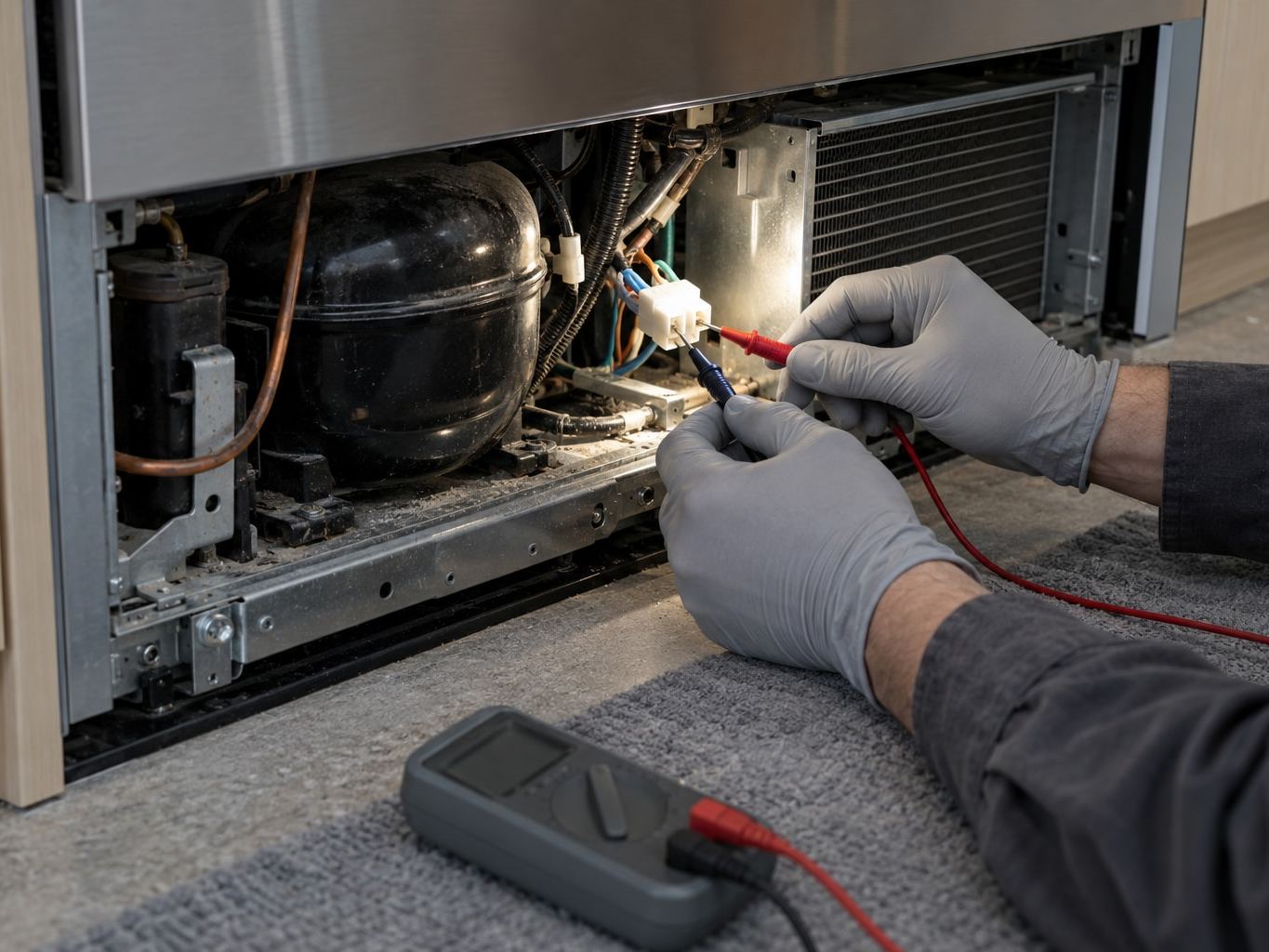
The instruments and what each one shows
| Instrument | What it shows | Why it matters |
|---|---|---|
| Digital thermocouples | Actual air temperature in each zone, logged over time | Separates a wrong display from a genuine temperature problem |
| Refrigerant gauges | Pressures inside the sealed system | Points to a leak, a restriction or a compressor that isn't pumping |
| Multimeter and clamp meter | Voltage, continuity, compressor and fan current | Finds failed relays, heaters, fan motors and wiring faults |
| Control board testing | Whether the board sends and receives the right signals | Avoids replacing a costly board that isn't at fault |
| Manufacturer diagnostic routines | Stored fault codes and component self-tests on models that support them | Shows what the unit itself has recorded |
When to ask for a diagnosis rather than a repair
These are the cases where the cause isn't obvious and guessing gets expensive.
- Problem comes and goes
- Likely cause A relay, sensor or fan that misbehaves only when warm — needs measuring over time, not a single look
- Code on the display
- Likely cause A circuit or sensor flagged by the control; the failed part still has to be confirmed
- Runs longer, electric bill creeping up
- Likely cause Dusty condenser, a weak gasket, a fan losing speed or a sealed-system issue See the repair
- New clicking, buzzing or rattling
- Likely cause Fan motor, compressor start parts, or a panel or tray vibrating against the cabinet See the repair
- Strange behaviour after an outage or storm
- Likely cause Control board, start relay or protective circuit hit by the surge
- Fresh food warm while the freezer is fine
- Likely cause On dual-system models the fault sits in one system only — its compressor, fan or sensor See the repair
- A quote you're not sure about
- Likely cause Second opinion: we measure independently and tell you whether we agree
Diagnosis questions, in plain words
- How long does a Sub-Zero diagnostic visit take?
- It depends on the symptom and the number of units. A clear fault is often confirmed quickly; an intermittent one may need the unit run through a full cycle while readings are taken. We tell you on the call what to expect for your case.
- Do you diagnose older Sub-Zero models?
- Yes, older generations as well as current ones. Part availability for very old units varies, so the report says plainly whether a repair makes sense and whether the part needs shipping in, which adds a return trip.
- Should I reset or unplug the unit before the technician arrives?
- Better not. A reset can wipe a stored code and let an intermittent fault hide. Photograph the display, note the time and leave it running — unless there's a burning smell, sparking or water near the electrics, in which case cut power at the breaker. If it has stopped cooling entirely, go to emergency repair; more general answers are on the FAQ page.