Sub-Zero repairColumns and drawers
Sub-Zero freezer repair before the stock thaws
A freezer is a pantry with a deadline: what it costs you when it fails is mostly what is inside it. This page covers how to buy time for the food, what a struggling Sub-Zero freezer is telling you, and how we track the fault down.
4.9 out of 5 from 150 client reviews Rating details
Readings a failing freezer gives you
A Sub-Zero freezer should sit at 0°F. When it cannot, it usually shows one of these patterns first. Note which one you see; it shortens the visit.
- Ice cream soft, readout above the setting
- Likely cause Condenser starved of air, a weak compressor or, rarely, a refrigerant leak
- White frost on the walls, food coated in crystals
- Likely cause Automatic defrost has quit (heater, defrost thermostat or timing control), or warm air is getting past the gasket
- Compressor hums for hours without a break
- Likely cause Dirty condenser, a door that does not seal, or a thermostat or sensor that never reports the target as reached
- Door or drawer closes but does not grip
- Likely cause Torn or flattened magnetic gasket, a sagging hinge or a drawer slide that has slipped out of line
- Cold at the bottom, warm near the top, fan noise behind the back panel
- Likely cause Evaporator fan motor failing or a blade striking ice
- Ice maker has slowed down or stopped
- Likely cause Often a symptom of the freezer running warm rather than a fault in the ice maker itself See the repair
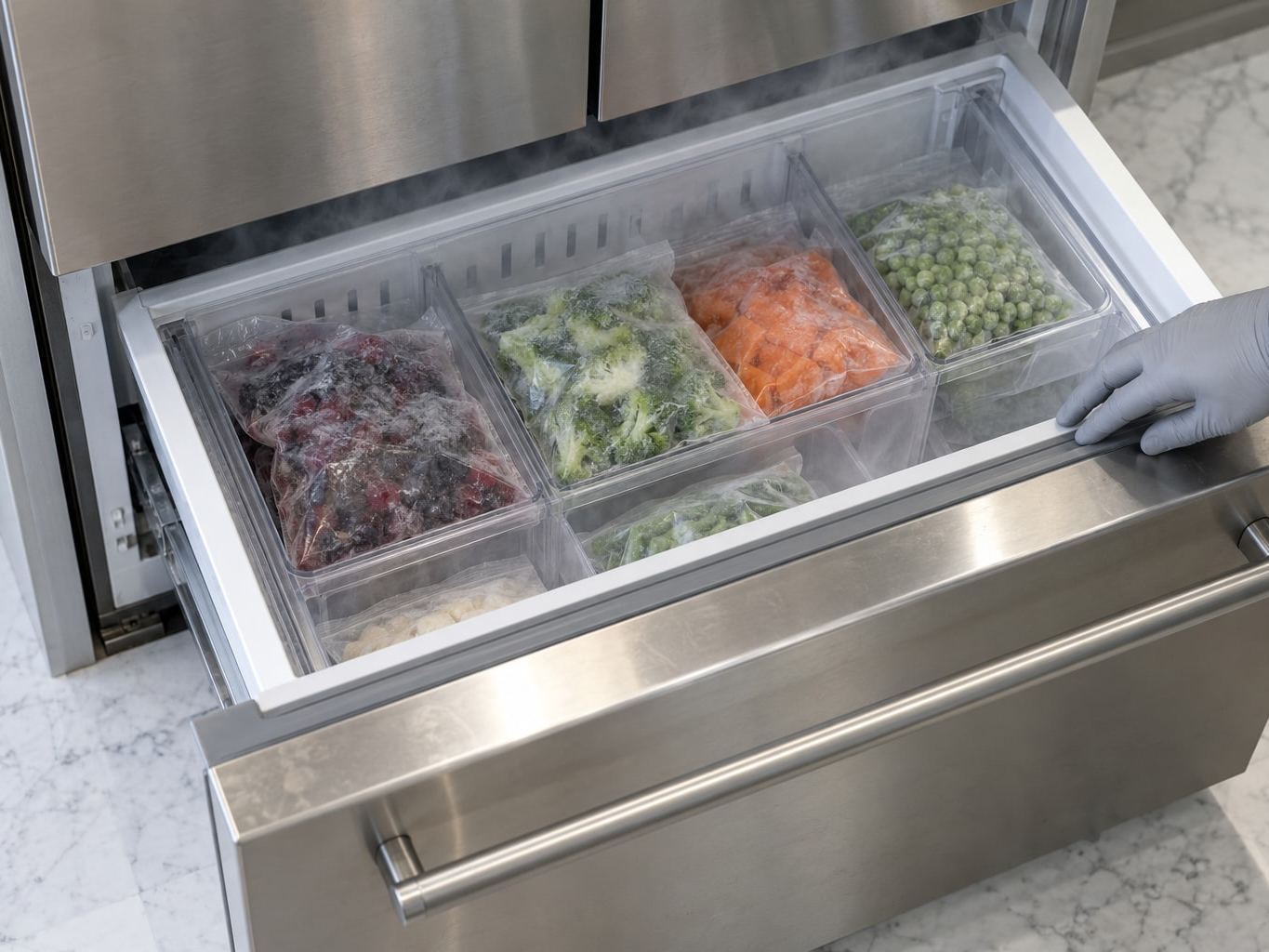
Protect the stock first
Careful
Keep the door shut and let the cold work for you
As a rough guide rather than a promise, a full freezer that stays closed can hold its cold for up to about 48 hours, while a refrigerator manages around four. Every opening costs you some of that time.
- Keep the door or drawers closed unless you are moving food out
- Group frozen items tightly together; a packed freezer stays cold longer than a half-empty one
- Do not add warm groceries until the unit is repaired and back at temperature
- If something has fully thawed and you are unsure about it, follow standard food-safety advice and throw it out
- If you see sparks or smell burning, switch the freezer off at the breaker and do not touch it with wet hands
From your call to a freezer that holds 0°F
No two repairs take the same time, so here is the order of events rather than a clock.
-
On the phone
Tell us the model if you can see the label, what the readout says and what you have already noticed. We offer the first open slot; we pick up 24/7 and send technicians daily, 8 AM–6 PM. If it is the middle of the night, we explain how to keep the stock frozen until the technician arrives.
-
At the door
In a high-rise we have already sorted the concierge, the freight elevator and any building notice. The technician protects the floor in front of the unit before opening it.
-
Diagnosis
Temperatures are read with a probe, the condenser and fans are checked, the gaskets are tested along their full length, and the defrost parts and sensors are measured, not just looked at.
-
Before any repair
You get the cause, the part and the price in plain language, and you decide. Approve it and the $89 trip charge is taken off the total.
-
The fix
Many freezer repairs are finished in one visit. Sealed-system work such as a compressor, or a part ordered for your model, means a second appointment.
-
Before leaving
The technician watches the unit through a full cooling cycle where possible, confirms it is pulling down toward 0°F and checks that any connected ice maker is filling again.
Column freezer or freezer drawers: what changes
Sub-Zero builds freezers as full-height columns and as drawers under the counter or inside a combination unit. The fault list overlaps, the work does not.
Full-height column freezer
- Evaporator and fan sit behind a panel at the back of the cabinet, so shelves and baskets come out first
- Machinery and condenser are usually reached through the grille at the top, often above head height
- Large door, so a sagging hinge or a tired gasket lets in a lot of warm air
- Often paired with a refrigerator column; one visit covers both
Drawer and undercounter freezers
- Each drawer has its own gasket and slides, so one misaligned drawer can frost up while the others are fine
- Condenser sits low and gathers floor dust and pet hair faster
- Less space inside, so a small temperature swing shows up quickly on the food
- Tight cabinet installations need care to avoid marking surrounding panels
Either way, the visit starts the same: measure, test, explain, then repair. If your drawers live under a bar or in a second kitchen, the undercounter repair page covers the installation side in more detail.
Freezer questions, answered plainly
- What temperature should my Sub-Zero freezer be?
- 0°F. If the display shows 0°F but a thermometer between packages reads well above it, the sensor or control may be off, which is worth telling the technician.
- My freezer runs all the time. Is that a problem?
- A freezer should cycle on and off. Running for hours without a pause usually points to a dusty condenser, a gasket leak or a sensor that never reports the target as reached. It wears the compressor and wastes power, so it is worth a visit before it turns into a warm freezer.
- Can I melt the ice myself with a hair dryer?
- No. Do not use a hair dryer or any other heat inside the unit: direct heat can warp the plastic liner and melt water can reach wiring. If the ice is around the ice maker, turn off its water supply too, then call us. Turning the unit off to melt the frost also hides the fault for a few days without fixing it. Leave the frost in place so the technician can see the pattern.
- What should I do if it fails late at night?
- Phone anyway: a person answers 24/7. Keep the door closed and read the emergency steps for protecting food. The technician comes during visiting hours, daily, 8 AM–6 PM, and you can see how the price is set before then.